
Wix has made website creation accessible to almost anyone. Pick a template, customize the design, connect a domain, publish — no developer required.
But Wix alternatives are worth knowing. Some users need more design control. Others want stronger CMS capabilities, better ecommerce tools, a lower price, or a platform built specifically for lead generation. The right pick depends on what kind of website you are building and how you plan to use it.
Here are seven platforms worth considering in 2026.
Quick Comparison
| Platform | Best for | Starting price |
|---|---|---|
| Onepage.io | Websites, landing pages & lead generation | Free plan |
| Webflow | Professional design & CMS | Free plan |
| Squarespace | Design-focused business websites | Free trial |
| Framer | Modern, design-led websites | Free plan |
| Hostinger Website Builder | Affordable websites & small businesses | Paid plans |
| WordPress.com | Flexible content websites | Free plan |
| Shopify | Ecommerce websites | Paid plans |
1. Onepage.io — Best Wix Alternative for Lead Generation
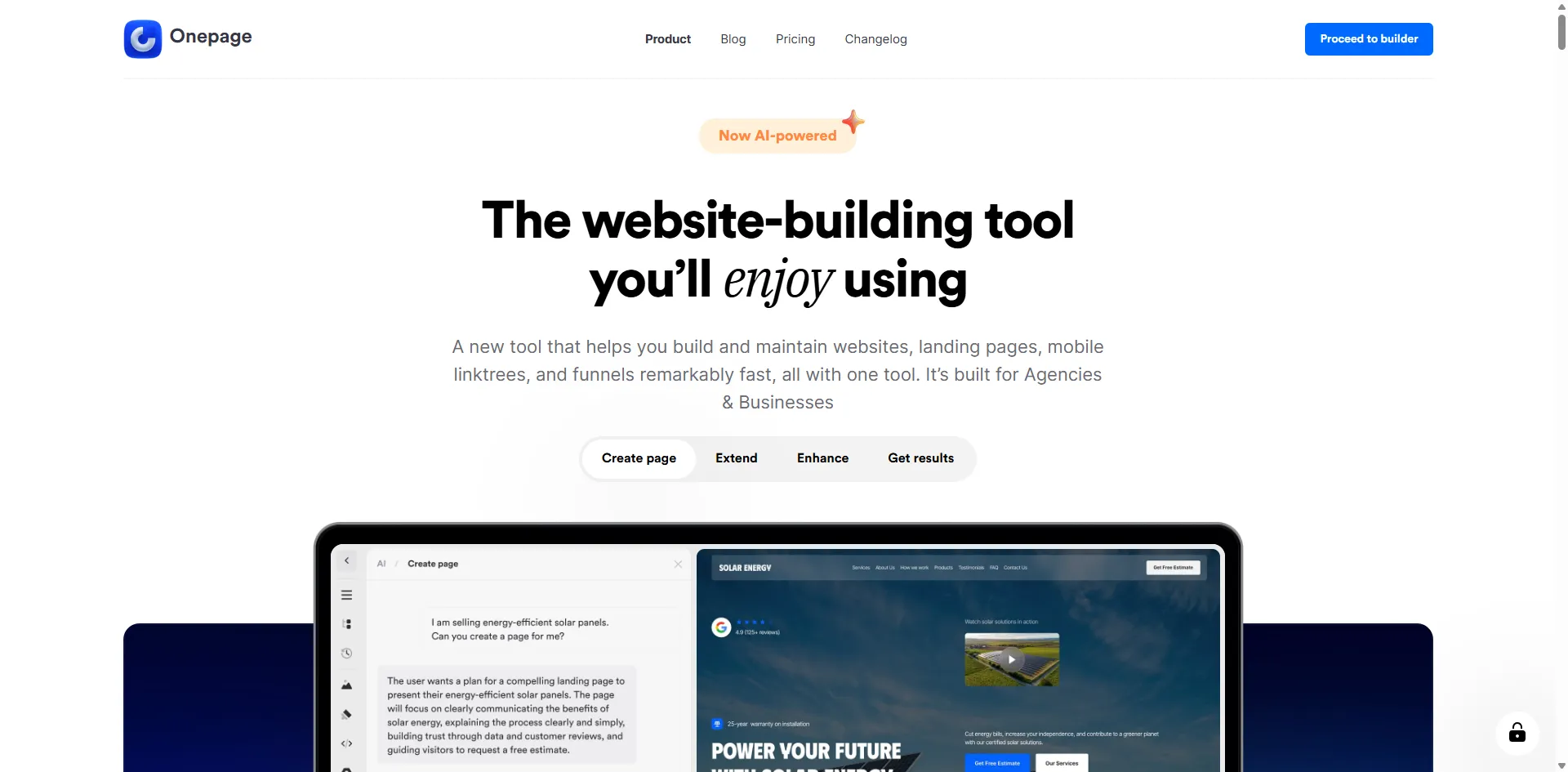
Onepage.io approaches website creation with a focus on getting pages online quickly while also providing tools for lead generation and conversion. That combination — website builder plus lead-gen functionality in one platform — is what makes it a strong Wix alternative for businesses that need more than an online brochure.
The current platform includes website building, custom domains, analytics, SEO functionality, integrated CRM, custom HTML/CSS, and automation integrations via Zapier and Make. The Forms & Funnels add-on adds multi-step forms, quizzes, and conversion funnels.
Onepage has a free plan. Paid plans (Essential, Standard, Advanced, Expert) start at $19.90/month for the Essential tier.
Best for: Businesses, marketers, agencies, and service providers that want websites and landing pages with built-in lead-generation functionality.
Pros
- Free plan with no trial-period requirement
- Website builder, landing pages, and integrated CRM in one platform
- SEO tools and website analytics included
- Multi-step forms, quizzes, and conversion funnels via add-on
- AI-assisted page, section, and code generation
- Zapier and Make integrations
- Custom domains on paid plans
Cons
- Forms & Funnels functionality is an add-on, not included by default
- Not an ecommerce-first platform
- Smaller app ecosystem than larger platforms like Wix or WordPress
2. Webflow — Best for Design Control
Webflow sits between a visual website builder and a professional web-development environment. You do not need to write traditional code, but the platform gives designers significantly more control than beginner-oriented builders.
The current platform covers visual website building, CMS functionality, hosting, AI tools, and development-oriented features. The free Starter plan is available, with the Basic site plan at $15/month (billed annually), supporting up to 300 static pages and 10 GB bandwidth. Higher plans add CMS and additional capabilities.
Best for: Designers, agencies, startups, and businesses that need deeper design control.
Pros
- Advanced visual design editor with pixel-level control
- Full CMS for structured content
- Responsive layout controls
- Custom interactions and animations
- Hosting included
- AI tools
- Strong designer and developer ecosystem
Cons
- Steeper learning curve than beginner-focused builders
- Can be intimidating for users without a design background
- More complex than necessary for a basic business website
3. Squarespace — Best for Polished Business Websites
Squarespace is known for its high-quality templates and design-first approach. The platform includes a drag-and-drop editor, SEO tools, analytics, AI functionality, ecommerce, and support for digital products, courses, videos, and memberships.
It is particularly suited to portfolios, professional services, creative businesses, and brands where the website itself is part of the customer experience.
Best for: Designers, creatives, consultants, and businesses that want a polished website without complex configuration.
Pros
- High-quality, design-focused templates
- Drag-and-drop editing
- SEO tools and analytics
- Ecommerce and digital product support
- Courses, memberships, and video content
- AI functionality
Cons
- Less flexible than Webflow for advanced custom design
- Some commerce features are plan-dependent
- Less extensible than WordPress for complex site structures
4. Framer — Best for Modern Marketing Websites
Framer has become a popular choice for designers and teams that want highly visual websites without a traditional development workflow. The platform combines visual design, CMS, SEO, AI features, collaboration, and hosting.
Framer has a free plan. The Basic plan is $10/month and Pro is $30/month at standard monthly pricing.
Best for: Designers, startups, portfolios, and modern marketing websites where visual design is the priority.
Pros
- Modern visual editor with strong design capabilities
- CMS and SEO tools
- AI functionality
- Hosting and collaboration included
- Free starting point
Cons
- Not the strongest choice for complex ecommerce
- Some advanced functionality requires add-ons
- Businesses with extensive content structures may prefer Webflow or WordPress
5. Hostinger Website Builder — Best Budget Option
Hostinger takes a straightforward approach: combine hosting, templates, AI website creation, and domain management into one affordable subscription.
Current India pricing lists the Premium plan at ₹149/month and Unlimited at ₹249/month on a 48-month promotional term. Both plans include templates, hosting, AI tools, and a free custom domain for one year. The Unlimited plan adds ecommerce and email marketing functionality.
Best for: Beginners, freelancers, and small businesses where price is the primary consideration.
Pros
- Very affordable entry pricing
- Hosting included with the subscription
- AI website creation tools
- Templates and custom domain on qualifying plans
- Ecommerce and email marketing on Unlimited plan
- 24/7 customer support
Cons
- Less design flexibility than Webflow or Framer
- Promotional pricing differs from renewal pricing — check before committing
- Advanced businesses will eventually need more specialized tools
6. WordPress.com — Best for Content and Extensibility
WordPress.com is a different proposition from Wix. It combines managed hosting with the WordPress ecosystem, giving users access to themes and — on paid plans — plugins.
The platform has a free plan. Paid plans (Personal, Premium, Business, Commerce) increase storage and capabilities. The Business plan includes 50 GB of storage and plugin installation. The Commerce plan is aimed at online stores.
WordPress is particularly strong when content is central to your website: blogs, publications, resource libraries, and sites requiring extensive customization.
Best for: Bloggers, publishers, content-heavy websites, and businesses that need plugin-based extensibility.
Pros
- Free plan available
- Massive plugin and theme ecosystem
- Strong blogging and content management
- Ecommerce via WooCommerce on paid plans
- Managed hosting with automatic updates
- Extensive customization on higher plans
Cons
- More configuration required than beginner-focused builders
- Plugin selection introduces complexity for non-technical users
- Some features require understanding the broader WordPress ecosystem
7. Shopify — Best for Ecommerce
Shopify is the specialist on this list. While Wix supports online stores, Shopify is designed around ecommerce from the ground up — product management, inventory, payments, and multi-channel selling are core features rather than add-ons.
Current India pricing lists Basic at ₹1,499/month (billed annually), Grow at ₹5,599/month, and Advanced at ₹22,680/month. All plans include unlimited products, inventory management, and selling across social channels and marketplaces.
Best for: Ecommerce businesses and online retailers where selling products is the primary purpose of the website.
Pros
- Built for ecommerce from the ground up
- Unlimited products across all plans
- Inventory management and multi-channel selling
- Large app ecosystem for extending store functionality
- Scalable plans as the business grows
- Payments and checkout built in
Cons
- Expensive and unnecessarily complex for a simple informational website
- Transaction and payment costs can vary by setup and region
- Not a general-purpose website builder
Which Wix Alternative Should You Choose?
The right choice depends on what you are building:
- Onepage.io — websites with landing pages, CRM, forms, and funnel functionality
- Webflow — professional design with full CMS control
- Squarespace — polished business or creative website with minimal complexity
- Framer — modern, design-led marketing site
- Hostinger — basic website on a tight budget
- WordPress.com — content-heavy website needing plugins and extensibility
- Shopify — online store where ecommerce is the primary goal
FAQs
What is the best free Wix alternative?
Onepage.io, Webflow, Framer, and WordPress.com all offer free plans. Onepage.io is the strongest free option if you need landing pages and lead-generation tools alongside a website.
Is Webflow better than Wix?
Webflow gives designers significantly more control over layout, interactions, and design output. Wix is easier for beginners. If design precision matters, Webflow is the stronger platform. If ease of use is the priority, Wix has a lower learning curve.
Is Squarespace a good alternative to Wix?
Yes. Squarespace has better template quality and a cleaner aesthetic than Wix. It supports ecommerce, digital products, memberships, and courses. It is a strong choice for service businesses, creatives, and consultants.
Which Wix alternative is best for ecommerce?
Shopify is the most capable ecommerce-focused option. Wix supports online stores, but Shopify is purpose-built for product management, inventory, multi-channel selling, and payment processing at scale.
Is WordPress.com better than Wix for blogging?
WordPress.com has better native blogging and content management than Wix. If publishing content regularly is central to your site, WordPress.com — especially on paid plans with plugin access — is the more extensible platform.
Is Wix Still Worth Using — Or Should You Switch?
Wix remains a capable all-purpose website builder with a broad template library and an extensive app market. It is a reasonable default for general business websites.
But it is not the automatic best choice for every use case.
Onepage.io is the strongest Wix alternative for businesses that want websites and landing pages with lead-generation tools built in. Webflow and Framer suit designers who want more visual control. Squarespace is the cleaner choice for polished, content-light business sites. Hostinger solves the price problem. WordPress.com covers content and extensibility. Shopify handles ecommerce better than any general-purpose builder.
The best Wix alternative is the one that matches how you plan to build, manage, and grow your website — not the platform with the longest feature list.